Interactive
Motion
Performance
When movement becomes the interface.
Movement → sensing → computation → visual response → performance
The Idea
I wanted to turn physical movement into a visual instrument. Instead of interacting with a screen, the performer becomes the controller.
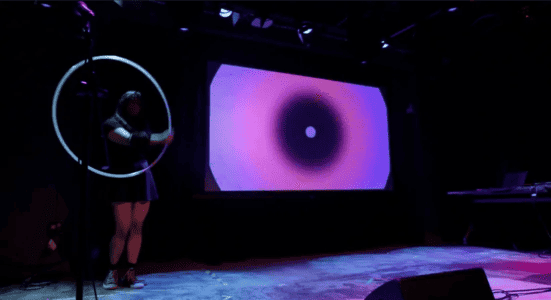
The performance paired wearable sensors with Arduino and TouchDesigner so that motion — an accelerometer and gyroscope worn on the body — directly drove real-time generative visuals. There was no mouse, no keyboard, no screen to touch. The body itself became the input device, and the visuals existed only because someone was moving.
The System
The Interaction
How movement became the interface.
Different physical movements were mapped to changes in the visual system, turning the performer's body into both the input and the source of the experience.
Orientation
From the gyroscope: how the performer's body was angled and turned.
Acceleration
From the accelerometer: how quickly and how hard the body was moving.
Visual response
In TouchDesigner, the real-time generative visuals that changed as that data changed.
The Performance
Live performance — visuals generated in real time from the performer's motion data.
Behind the Scenes
Sensing
An accelerometer and gyroscope, worn on the body, captured orientation and acceleration as raw motion data — the performer's movement as a stream of numbers.
Hardware
Arduino read the sensor data and passed it out over serial, acting as the bridge between the physical wearable and the software driving the visuals.
Visual Engine
TouchDesigner received the incoming data and mapped it to real-time generative visuals, so every shift in movement changed what appeared on screen.
Performance
The system was performed live — movement, hardware, and visuals running together in real time rather than as a pre-rendered demo.
What I Learned
Designing for the body changed how I thought about interaction.
Instead of designing what someone clicks or touches, I had to design how movement would feel when translated into a visual response.
My Role
It started as a performance idea and became a collision of hardware, software, movement, and visual art.